A sharing antipasti board isn’t a random assembly of whatever’s left in the fridge. It’s a precise gesture, one we repeat every evening before the dining room fills up: placing on the plate things that don’t share the same flavour, the same texture, the same temperature, and yet complement one another.
The gesture: what goes on, and in what order it’s arranged
We always start with what’s cold and dry: the charcuterie, coppa, bresaola, sometimes a salami thinly sliced on the machine. It goes on first because it holds up best, it loses nothing by sitting out in the air for a few minutes.
Next come the marinated vegetables, aubergines, peppers, artichokes in oil. They bring the acidity that charcuterie alone lacks. Then the cheeses, burrata or a mozzarella fior di latte cut just before serving, because it can’t bear to wait. Finally the bread, warm focaccia, and a drizzle of extra-virgin olive oil poured at the very last moment, never before.
The order isn’t just for show. A board assembled the wrong way round, cheese first and charcuterie last, falls apart midway through service: the cheese sweats, the charcuterie sweats in turn, and everything blends together in the plate before it even reaches the table.
Why this order really changes the result
The professional rule is to arrange the elements from most stable to most fragile, working from the edge of the plate towards the centre. What fears heat or moisture — burrata, warm focaccia — goes on last, just as the board is about to head out to the dining room. What holds up — charcuterie, vegetables in oil — can wait without harm.
Contrast matters too: a successful Italian antipasti alternates fat and acidity, crunch and smoothness. A board that’s nothing but charcuterie tires the palate after three bites. A board that alternates bresaola, marinated pepper, a little parmigiano reggiano DOP and a trail of oil keeps the appetite going with every round.
We often see the opposite mistake in the dining room: a board where everything is served cold and dry, with nothing to break up the texture. It gets eaten quickly, but it doesn’t open up the appetite, it shuts it down. That’s why we always make a point of slipping in something soft and melting, burrata or mozzarella, even on a board built mainly around charcuterie.
What this requires: the technique, the time, the space on the table
This gesture demands time that can’t be made up for in the kitchen. The charcuterie is sliced to order, not in advance, otherwise it dries out. The mozzarella is cut just before it goes out, never kept in reserve. The marinated vegetables, meanwhile, are prepared the day before: they need time to take on the oil and herbs, unlike everything else, which is done at the last minute.
It also calls for real discipline in composition: an overloaded board loses its purpose, no one knows where to start, and half of it ends up lukewarm before it’s even been tasted. We prefer a thoughtfully composed board, with a limited number of well-chosen elements, rather than a pile-up.
Finally, it requires space on the table. A sharing antipasti board goes in the centre, not off to one side, because it invites several hands at once. It’s a dish you eat by gathering around, not by taking turns being served. This also changes how a table should order: it’s better to have one large board for everyone than several individual small plates, because sharing is what holds the balance between flavours together. An individual board, served too quickly, forces you to eat everything out of order, and the very idea of progression disappears.
What this gives on the plate, and for how many people
On the plate, that same order plays out: you start with the charcuterie and bread, move on to the vegetables that revive the palate, and finish with the cheese that softens everything before the main course. It’s a progression, not a static buffet.
As for how many people it serves, it all depends on what’s planned afterwards. A board conceived as a genuine Italian sharing starter, ahead of pizze and pasta, properly feeds two to four people as a starter. If it’s meant to be a meal in itself, it’s best to double it or add a cheese board alongside. A table of six or eight people wanting to sample a bit of everything before the pizze would do better to order two different boards rather than one very large one: that way the charcuterie is sliced at the last minute, without having to wait for it to make its way round the whole table. You’ll find the full range of formats and compositions on our antipasti and sharing board menu, with antipasti and boards offered according to the season.
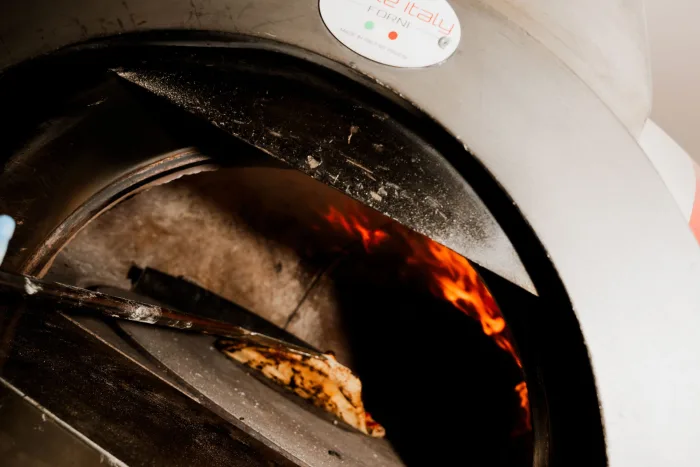
We perform this gesture just a few hundred metres from La Louvière-Centre station, and not far from the Musée Ianchelevici either: the antipasti board is often what opens the meal for people strolling in from the town centre, before a pizza baked in the wood-fired oven.
Come and see for yourself, or order to take home
The best way to understand this order is to watch it arrive at the table and finish it off over conversation. We serve this board at both lunch and dinner, except on Tuesdays when the restaurant is closed. For a group meal or an evening spent taking the time to share several boards before the pizze, you can also book the dining room: the details are on the private hire page. Otherwise, simply drop by, take a seat, and start with the charcuterie.
To share antipasti at the restaurant, contact us to book your table, letting us know how many guests will be joining.