We get asked this question almost every week in the dining room: “is yours real Neapolitan pizza?” The question stems from a common confusion, because in Belgium many pizzerias mix the two schools without saying so. The difference between Neapolitan and Roman pizza isn’t just a purist’s detail, though. It’s two doughs, two cooking methods, two ways of eating.
Why the two are so often confused
The fault often lies with the menu itself. Many pizzerias call any round pizza with mozzarella “Neapolitan”, without distinguishing thickness or cooking method. Yet in Naples, pizza follows precise rules for dough and oven. In Rome, another tradition developed, with a thin, crispy dough designed to be cut into rectangular slices or served as a very thin disc. Both are Italian, both are legitimate, but they’re not eaten the same way.
What we’re actually comparing
To judge fairly, we need to agree on the criteria. We’ve settled on three, which are enough to decide:
- The hydration and kneading of the dough, which determine the texture in the mouth.
- The time and temperature of fermentation, which give digestibility and flavour.
- The cooking, its duration and heat, which fix the final result: a puffed-up rim or a crispy disc.
Once these three points are established, the comparison becomes concrete rather than a matter of vague taste.
The dough: soft in the centre or thin all over
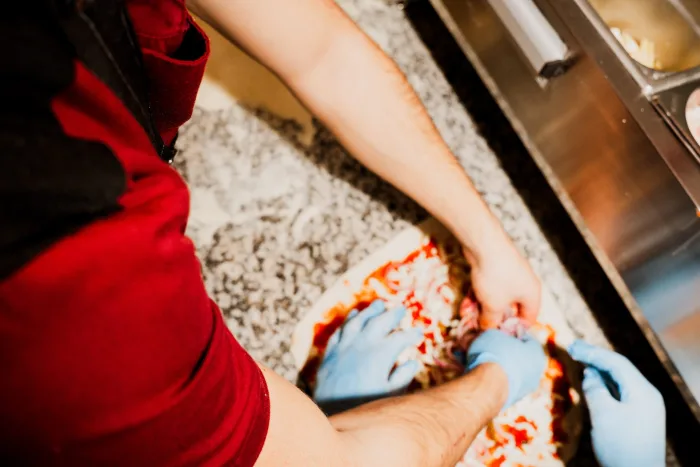
Neapolitan dough is worked to give a thick, airy rim, the famous cornicione, while the centre stays soft, almost moist beneath the topping. Roman dough aims for the opposite: a thin, even thickness from centre to edge, with no rise in volume. You can’t achieve this result with the same flour or the same shaping technique — Roman dough requires a finer, more precise rolling out, almost with a rolling pin in some establishments, whereas Neapolitan dough is worked by hand to preserve the air within it.
Fermentation: what happens before the oven is even lit
This is often where the real difference in flavour lies. A dough that has fermented for a long time develops more complex aromas and is easier to digest, because the sugars and gluten have had time to transform. Here, our dough rests for 48 hours in the cold before being worked. This choice aligns more with the Neapolitan ethos, where long maturation is a requirement, not an option. Crispy Roman dough can also ferment for a long time, but the final goal is different: we’re after firmness and crunch, not rise.
The cooking: a few dozen seconds that change everything
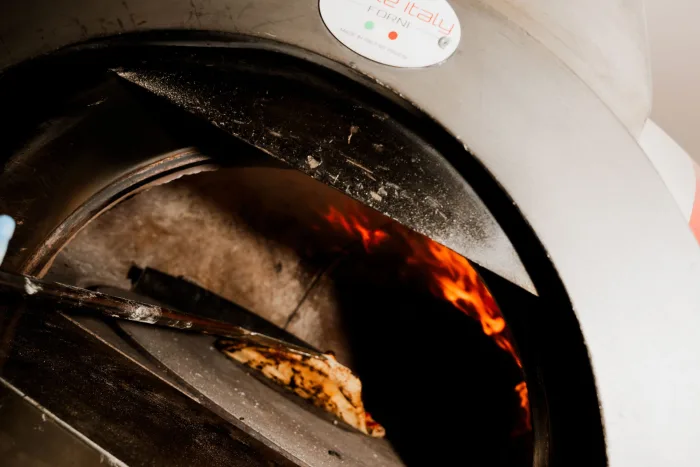
In Naples, cooking is very fast, in an oven heated to very high temperatures: the rim colours and puffs up almost instantly while the centre stays tender. In Rome, cooking is longer and less fierce, precisely to dry out the dough and achieve the crispness it’s known for. The wood-fired oven we use is designed for the first method: a fierce heat, a short cooking time, a result that leaves the rim soft and lightly puffed rather than dry.
What we’ve chosen at Mamma Maria, and what it means
We’ve made a clear choice: the Neapolitan school, with its 48-hour cold-matured dough and fierce wood-fired cooking. We stand by it, along with the ingredients that go with it — fior di latte mozzarella, San Marzano tomatoes, DOP parmigiano reggiano, extra-virgin olive oil. This choice comes at a cost: we don’t offer the thin, crispy Roman version, and some customers used to that style might be surprised by our thicker, softer rim. We’d rather say so clearly than blur the lines on the menu. Everything is detailed on our pizza menu, with sizes and toppings.
We can also tell this story in more detail: how we manage fermentation and the ingredients we import is explained in our article on the 48-hour dough and the wood-fired oven. And if your real question is about portion sizes and how many people a pizza will feed, you’ll find the figures in our article on how many people a pizza serves.
Where to come and taste the difference
The best way to understand a difference in dough is still to feel it under your teeth. We’re open 7 days a week except Tuesdays, lunchtime from midday to 2.30pm and evenings from 6pm to 10.30pm, just a short walk from La Louvière-Centre station and a few minutes on foot from the Musée Ianchelevici. Come and order a wood-fired pizza, to eat in or take away, and judge for yourself whether the puffed-up rim and long-fermented dough speak to you more than Roman crispness.
To come and try our wood-fired dough, contact us to book a table.