We’re asked this question almost every service: why don’t you put mozzarella di bufala on your pizzas? Bufala has a reputation that precedes it, a name that sounds more refined on a menu. But between what people believe and what actually happens in the wood-fired oven, there’s a gap we see every day in the kitchen.
The question arises because both cheeses genuinely exist, and they don’t share the same milk, the same texture or the same use. Mixing the two up is a bit like asking for a Neapolitan dough cooked like a Roman one: it doesn’t work, for similar reasons. We’ve actually gone into this other mix-up in our article on Neapolitan versus Roman pizza, if you’re interested in the dough side of things too.
What we’re actually comparing between these two mozzarellas
Before making a decision, you need to know what you’re looking at. Three criteria matter for a pizza, not for a charcuterie board or a caprese salad where bufala shines unrivalled:
- Water content, which determines what happens during cooking
- How it holds up to the heat of the oven, which decides whether the cheese melts or collapses
- The taste once hot, which is very different from the taste when cold
These are the three points that explain why an excellent cheese in its own right can be a poor choice on a pizza.
Water content, and what it does to the dough
Mozzarella di bufala is made with buffalo milk, which is richer and fattier, and it retains far more whey than fior di latte. Cold, on a plate, that water is part of its charm: it runs a little when you cut it, it’s soft, almost creamy.
In the oven, that same water becomes a problem. It’s released under the heat and soaks the centre of the pizza. The dough, which took 48 hours to develop its structure in the cold, ends up drowned before it’s even finished cooking. We lose the crispness of the crust, we lose the structure of the centre, and we often end up with a pizza that has to be eaten with a fork because it no longer holds together in the hand.
How it holds up to heat, what changes in a wood-fired oven
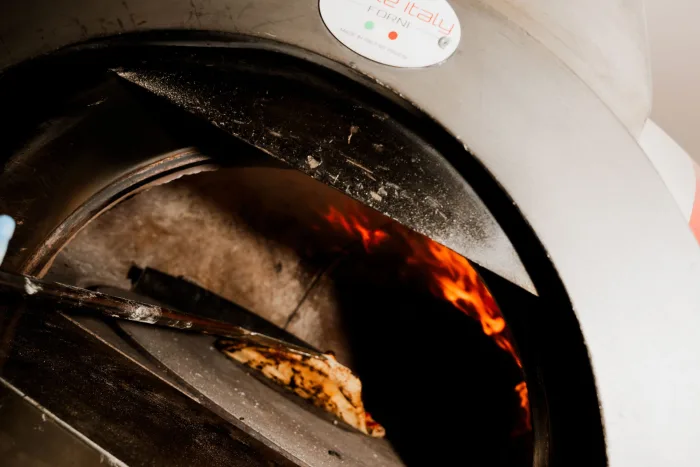
Our wood-fired oven reaches high temperatures, and the pizza is cooked within a matter of minutes. At that speed, the cheese doesn’t have time to release its water gradually: it all comes out at once. Fior di latte, being firmer and less laden with whey, withstands this thermal shock far better. It melts into an even layer, colours slightly, and keeps an elastic texture that works with the crust rather than fighting it.
Bufala, on the other hand, was designed to be eaten fresh, not to go through a wood-fired oven. That’s not a flaw in the cheese: it’s simply a use it wasn’t made for.
The taste once hot, the real surprise
You might think that bufala’s more pronounced flavour would make up for its fragility when cooked. In reality, the intense heat changes its aromatic profile: the milky, slightly tangy taste that makes it so appealing cold fades away, replaced by a flatter flavour, sometimes even a little sickly because of the fat that has melted into the released water. Fior di latte, by contrast, keeps that fresh, mild milk taste in the mouth, which leaves room for the other ingredients: San Marzano tomatoes, DOP parmigiano reggiano, basil. It’s a cheese that accompanies rather than dominates.
What we’ve chosen here, and what it costs
At Mamma Maria, we use fior di latte mozzarella on all our pizzas. It’s a deliberate choice, not a cost-cutting measure: good-quality fior di latte isn’t cheap either, but it does justice to our long-maturation dough and our wood-fired cooking. We’re not saying bufala is a bad cheese, far from it. We’re simply saying it belongs elsewhere, on a board, in a salad, served cold, where its moisture becomes an asset rather than a problem.
What does this choice cost us? Some customers arrive asking for bufala and leave understanding why we don’t use it. We’d rather take the time to explain than serve a cheese that would compromise the result we’ve been working towards for 48 hours of preparation. If you’re interested in the full method, we’ve detailed it in our article on the dough, the wood-fired oven and Italian ingredients.
Where to come and taste the difference
The best way to judge is to taste for yourself. All our pizzas, from the marinara to our signature creation, are made with this same fior di latte, as shown on our pizza menu and its toppings. We’re open seven days a week except Tuesdays, for lunch from 12.00 to 14.30 and dinner from 18.00 to 22.30. Drop by, order, and judge for yourself: it’s the only argument that really counts.
To choose your pizza or plan a visit, find our details to book a table.