We’re sometimes asked why we don’t simply use a local tomato for our sauce. The answer comes down to one word: San Marzano. It’s a precise variety, protected by a designation of origin, grown on volcanic land at the foot of Mount Vesuvius. It’s not a marketing name stuck on a tin, it’s a strict set of specifications.
The method: open the tin, crush, nothing else
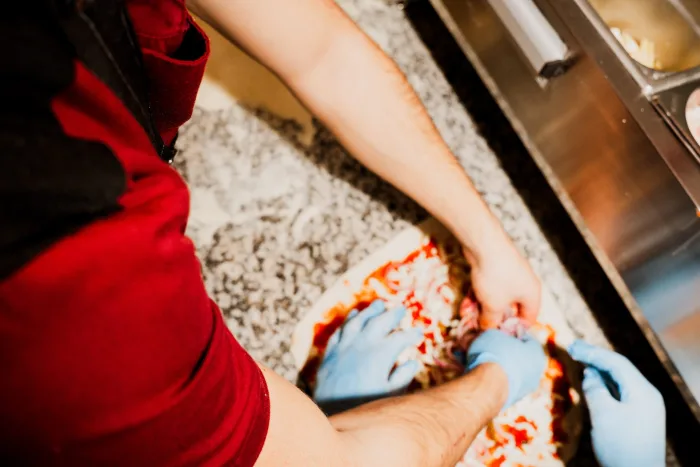
Our sauce isn’t a complicated recipe. We open the tins of San Marzano tomatoes, drain off a little of the excess juice, crush the tomatoes by hand or with a fork, add a touch of salt, sometimes a basil leaf. That’s it. No long cooking, no sautéed onion, no sugar to correct the acidity, no paste to thicken it. The method is simple because the raw ingredient does the work. A tomato that needs ten other ingredients to hold its own isn’t the right tomato. We could make something more elaborate, with extra herbs or a wine reduction, but that wouldn’t be plain San Marzano any more, it would be something else. The choice we make is to let the product speak for itself rather than dress it up.
Why this tomato changes the result
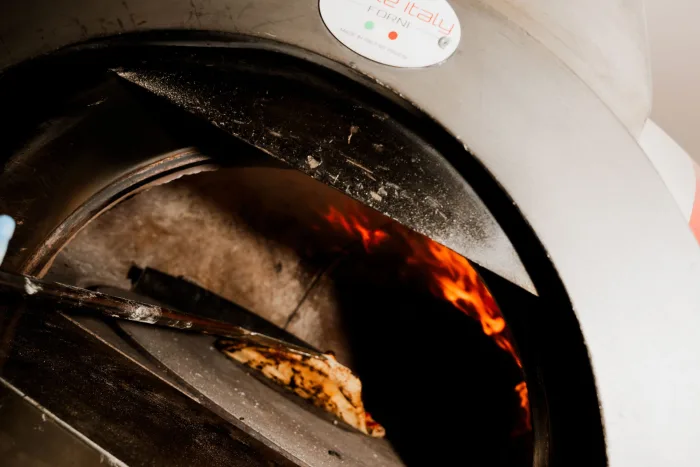
San Marzano tomatoes grow in a clearly defined area, in soil rich in volcanic minerals, with a particular level of sunshine. This gives a denser flesh, fewer seeds, skin that peels away easily, and above all a gentler acidity than most mass-produced tomatoes. On a pizza cooked in a wood-fired oven, where the sauce only cooks for a few minutes, that difference is immediately noticeable. A tomato that’s too acidic or too watery leaves the dough soggy and the sauce with a sharp aftertaste. San Marzano tomatoes, on the other hand, stay rounded, almost sweet without ever quite being so.
PDO status (Protected Designation of Origin) guarantees that what we buy genuinely comes from that area, grown in that way, rather than just any tomato packaged under the same name. Imitations exist, tins that use the San Marzano name without coming from the right region: the PDO mark is the only guarantee that really counts when buying in bulk. It’s the same logic we apply to our fior di latte mozzarella or our parmigiano reggiano: imported Italian ingredients because the result depends on it, not because it looks good on a menu.
What this means in the kitchen
The drawback is the price. A protected tomato, grown in a restricted area, costs more than a standard tinned tomato. We can’t make up for it with volume or switch supplier depending on which promotion is on: the PDO specifications don’t allow that kind of flexibility. We also have to accept not over-processing the tomato. The simple method described above is only possible because the raw ingredient is already good. If we had to hide a flaw, we’d be forced to add things, cook for longer, add sugar. Here, we take away rather than add, and that requires a degree of trust in the raw product.
One could argue that a local tomato, picked ripe in summer, would do just as well. That’s true for part of the year, in full season, once the sun has had time to do its work. But a pizzeria open all year round, every day except Tuesday, can’t rely on a seasonal harvest for its base sauce. Tinned San Marzano tomatoes guarantee a consistency that fresh local tomatoes simply can’t offer in January as much as in July. This requirement matches the one we apply to our dough, with its long 48-hour cold fermentation before baking in the wood-fired oven. A base that takes time and care shouldn’t be topped with a half-hearted sauce. The two go together, or neither is worth much on its own.
What it gives in the end
On a Margherita, this is where it all comes together: three visible ingredients — tomato, mozzarella, basil — nothing to hide behind. The San Marzano sauce gives a slightly sweet base that balances the saltiness of the parmigiano reggiano and the creamy texture of the fior di latte. You can also feel a difference in texture: less water escaping during baking, so the dough stays crisp beneath the topping rather than going soft in the middle.
On more heavily topped pizzas, with cured meats or grilled vegetables, the sauce stays in the background but still plays its part: it links the flavours without masking them. It never tries to dominate a rich topping; it acts as a base, a bridge between the melted cheese and whatever sits on top. It’s a difference you notice especially when comparing pizza after pizza, rather than in a single isolated bite. The whole menu is built on this same base, found from a classic pizza to a more generous version.
Come and taste the difference
The best way to judge is to compare it for yourself. We invite you to come and try a Margherita or another pizza from our Italian pizza menu and see if the sauce seems different from what you know elsewhere. We’re open every day except Tuesday, lunchtime from 12:00 to 14:30 and evening from 18:00 to 22:30, on Rue de la Loi in La Louvière, just a short walk from the station and the Musée Ianchelevici. For a private booking or any question about the menu, we’re happy to answer by phone or email.
Fancy tasting our sauce on a pizza? Contact us to book your table.